

25December
25th December, 2022

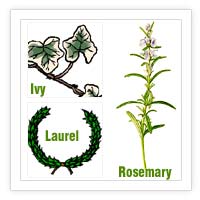
Ivy had been a symbol of eternal life in pagan religions. The Christians believe it stands for the new promise of eternal life. In England Ivy is considered to be feminine while holly is masculine. It was the ancient symbol of Bacchus, the god of wine and revelry.
The first Christians in Ancient Rome decorated their homes at the Saturnalia with laurel. Pagan Romans believed laurel was sacred to the sun god Apollo. When Romans became more Christian, laurel became a symbol of Christmas. In the Christian sect it came to symbolize the triumph of Humanity as represented by the Son Man. Bay is also a name used for laurel. As the bay tree, the true laurel of the Ancients, is scarce in England. Substitutions such the common cherry laurel, the Portugal laurel, the Aucuba and others are often used.
Rosemary was used during the Middle Ages by housewives to spread on the floor at Christmas. As people walked on it, a pleasant aroma arose. Tradition has it that the shrub is fragrant because Mary laid the garments of the Christ Child on its branches. The night he was born, legend has it, the trees suddenly bore fruit and flowers blossomed out of season. The name rosemary is given, too, an association to the Virgin Mary's name, making it all the more fitting for the Christmas season.


